
Workforce Intelligence
Move beyond static roles and start optimising real-world tasks. AWA reconstructs your "System of Reality" to recapture lost capacity and bridge the visibility gap that legacy tools ignore.
Agentic Workforce Architect (AWA)
We address a systemic Workforce Visibility Crisis where traditional planning relies on static, role-based snapshots that become obsolete almost immediately. AWA acts as a Behavioral AI platform that ingests raw, multi-channel telemetry, such as Jira logs, GitHub commits, Slack threads, to reconstruct the "System of Reality". By deconstructing these signals into atomic units of work, AWA surfaces:
Invisible Shadow Work
It uncovers necessary but unrecorded labor and ad-hoc coordination that traditional systems like Jira cannot track.
Workflow Dynamics
It maps actual collaboration patterns and bottlenecks, identifying where cognitive effort is misallocated.
Inefficiency Detection
It recognises routine, repetitive activities and identifies the context-switching tax that degrades team performance.
Strategic Reshaping
Using task-chaining theory, it uncovers role shortages and recommends new, blended skill-based models, such as a hybrid QA/Support/Operations role, to bridge operational gaps.
The platform’s Sovereign AI architecture ensures that all sensitive workforce data remains within local jurisdiction, providing compliance-by-design for the 2026 EU AI Act and UK data residency requirements. AWA delivers board-ready intelligence and models organisational workflows to drive peak operational efficiency.
Maximising workforce efficiency
We provide a multi-tiered approach to ensure your budget drives measurable ROI.
Discovery
Behavioural AI Platform. Our reasoning engine ingests company signals to map actual workflows and shadow work invisible to traditional systems. This exposes operational gaps and identifies exactly where Agentic AI, process or roles adjustments are needed.
Delivery
We deliver bespoke solutions, from autonomous workflow orchestrators to custom LLM integrations, designed to bridge operational gaps, drive productivity and increase organisation efficiency.
Scale
To ensure long-term success, we provide the specialised engineering talent to develop, deploy, and support your systems in-house, seamlessly integrating with your existing team.
The Technology
The System of Reality
Mapping multi-channel telemetry (e.g. Jira, GitHub, Slack) into atomic units of work to expose bottlenecks.
HRDL Algorithm
Utilising Hierarchical Reward Design from Language to autonomously decompose business goals into sub-tasks.
Sovereign AI
Architected for local jurisdiction and private environments to ensure 100% compliance with the 2026 EU AI Act and UK data residency.
Operational Visibility in Practice
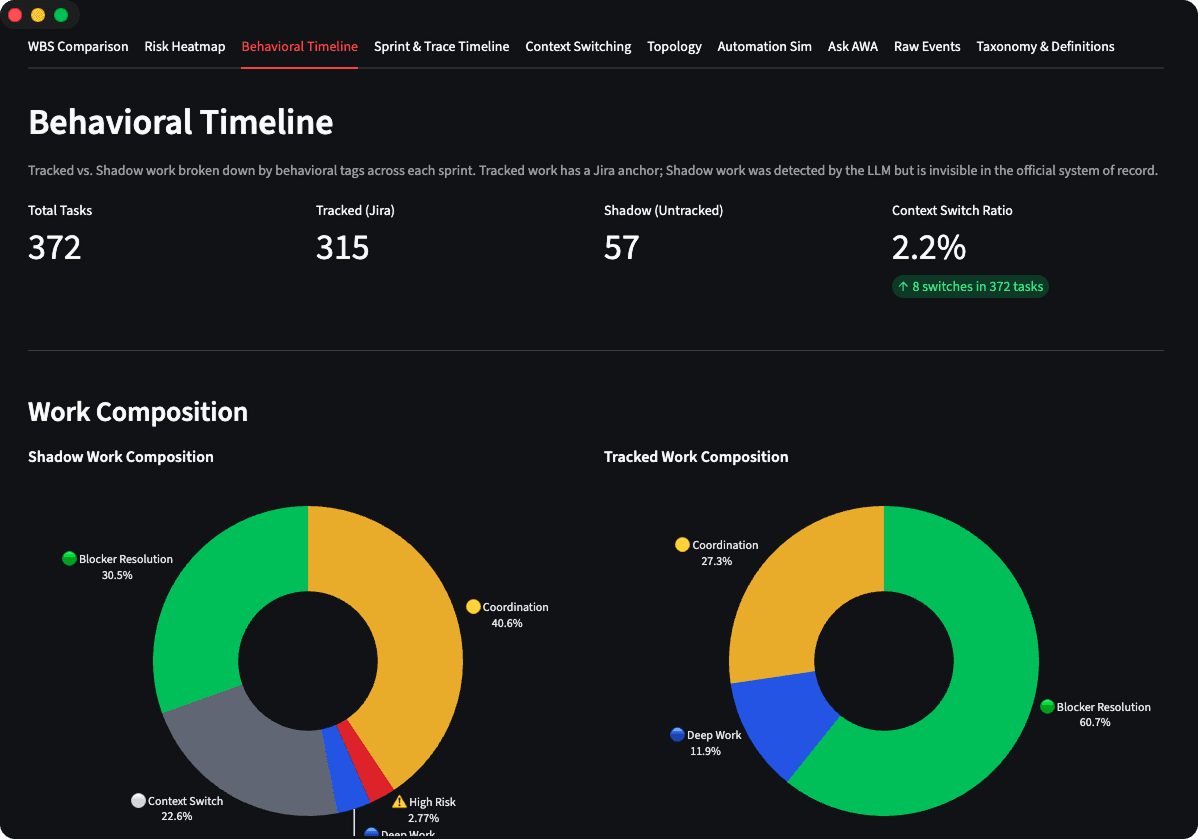
Quantifying the "System of Reality"
The view of organisational effort cross-referencing official logs with agentic behavioral detection. It visually separates the work that is formally governed from the untracked activities that directly impacting actual delivery velocity.
- Behavioral Work Composition: A granular breakdown of how cognitive effort is distributed across coordination, blocker resolution, and deep work.
- Shadow Work (Untracked): Necessary project work that is completely untracked in the official system of record (Jira). It captures critical but invisible activities including ad-hoc mentoring, environment debugging, and manual data wrangling.
- Tracked Work (Jira): Tasks with a direct anchor in the system of record, mapped against their actual behavioral tags.
- Context Switch Ratio: A real-time measure of cognitive friction, identifying the frequency of task-switching that degrades team performance and productivity.
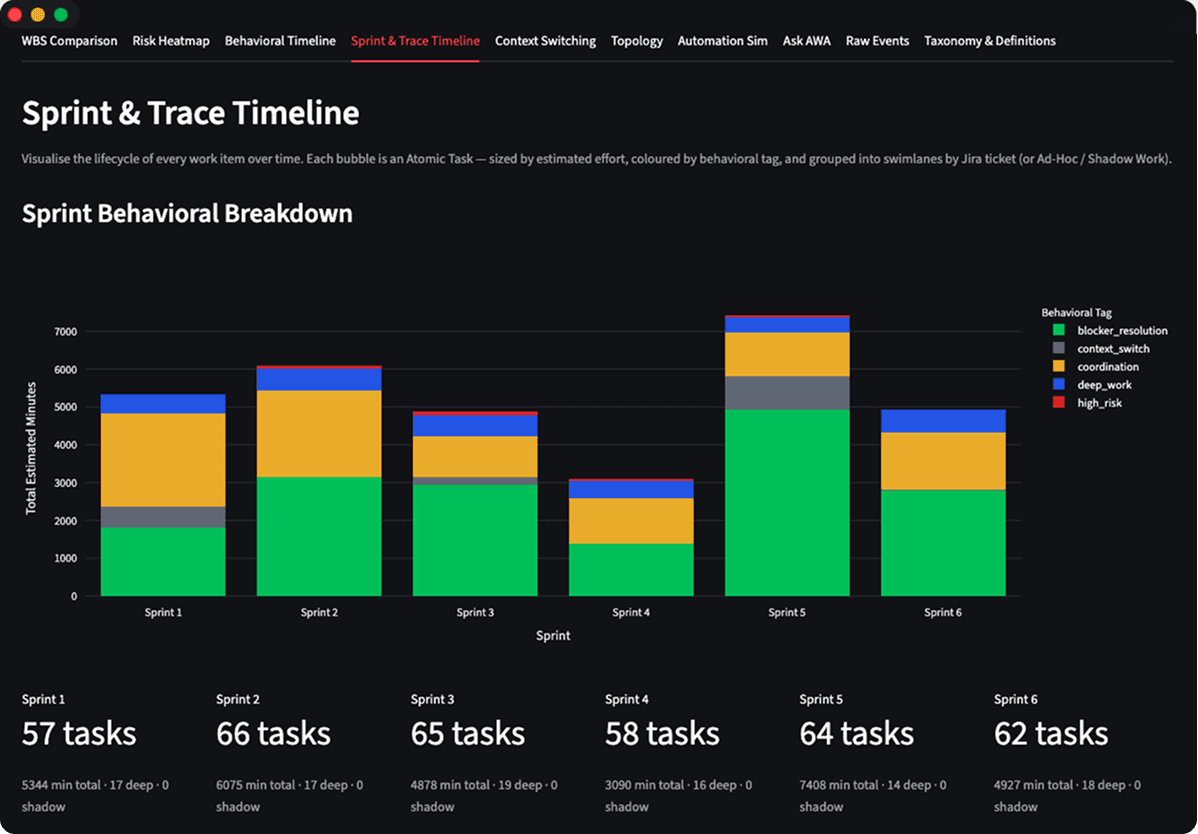
Tracking Work Trends Over Time
This view provides a historical map of how work actually gets done across different weeks and sprints. By looking at work over longer periods, AWA identifies hidden patterns in team activity and reveals the true "heartbeat" of your delivery cycle.
- Sprint-by-Sprint Health: A clear breakdown showing if your team's time is being spent on progress or being drained by constant blockers and meetings.
- Task Lifecycle: Follows every individual work item from start to finish, revealing the actual effort required beyond what is logged in official tickets.
- Deep Work vs. Noise: Identifies whether teams are finding the "focus time" needed for complex tasks or if they are trapped in a cycle of coordination.
- Historical Trace: Automatically captures the history of "invisible" work that usually disappears from memory, providing a complete record of every project contribution.
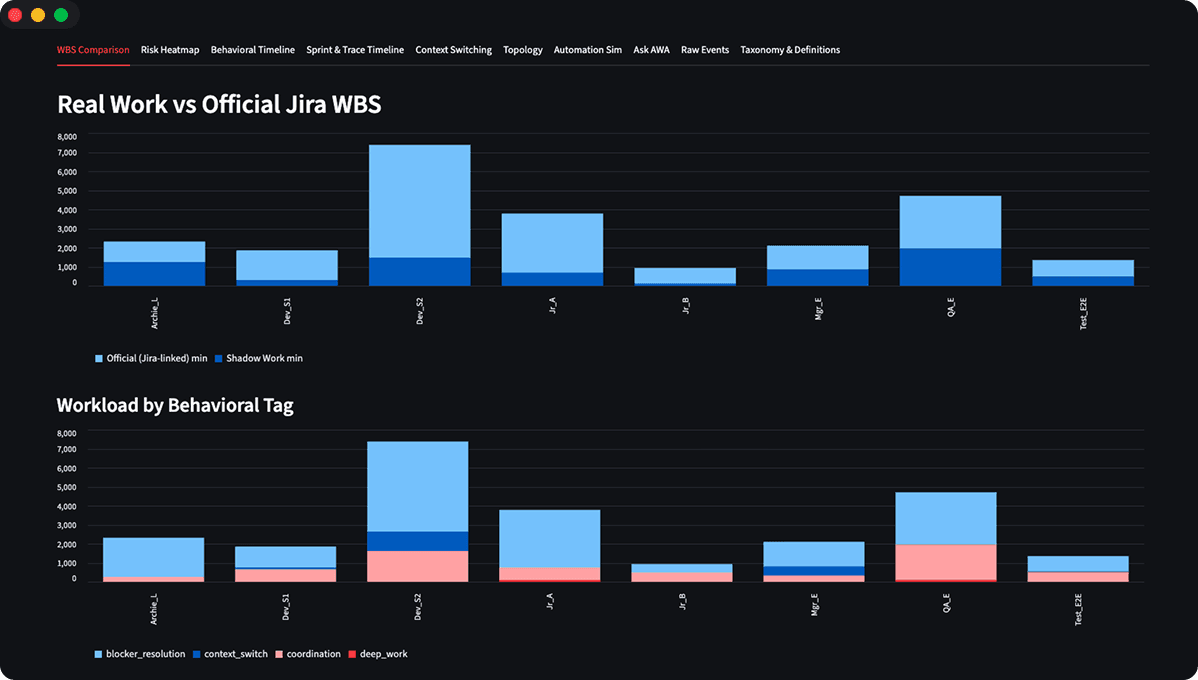
Comparing Real Effort vs. Official Records
This comparison highlights the gap between what is documented in project management tools and the actual workload required to deliver results. By mapping every minute of activity, AWA exposes the "Productivity Paradox" where significant effort is often spent on unrecorded tasks.
- Real vs. Official Workload: A side-by-side view showing the time officially linked to Jira tickets versus the "Shadow Work" minutes detected by our behavioral engine.
- Workload by Behavioral Tag: A detailed breakdown of individual team members' time, categorised by the type of activity, such as deep work, coordination, or blocker resolution.
- Identifying Overload: Spotlights high-pressure areas where team members are performing far more work than the official system shows, preventing burnout and ensuring realistic planning.
- The "Invisible" Work Gap: Directly visualises the necessary but unrecorded labor, like ad-hoc mentoring or manual data wrangling, that traditional snapshots miss.
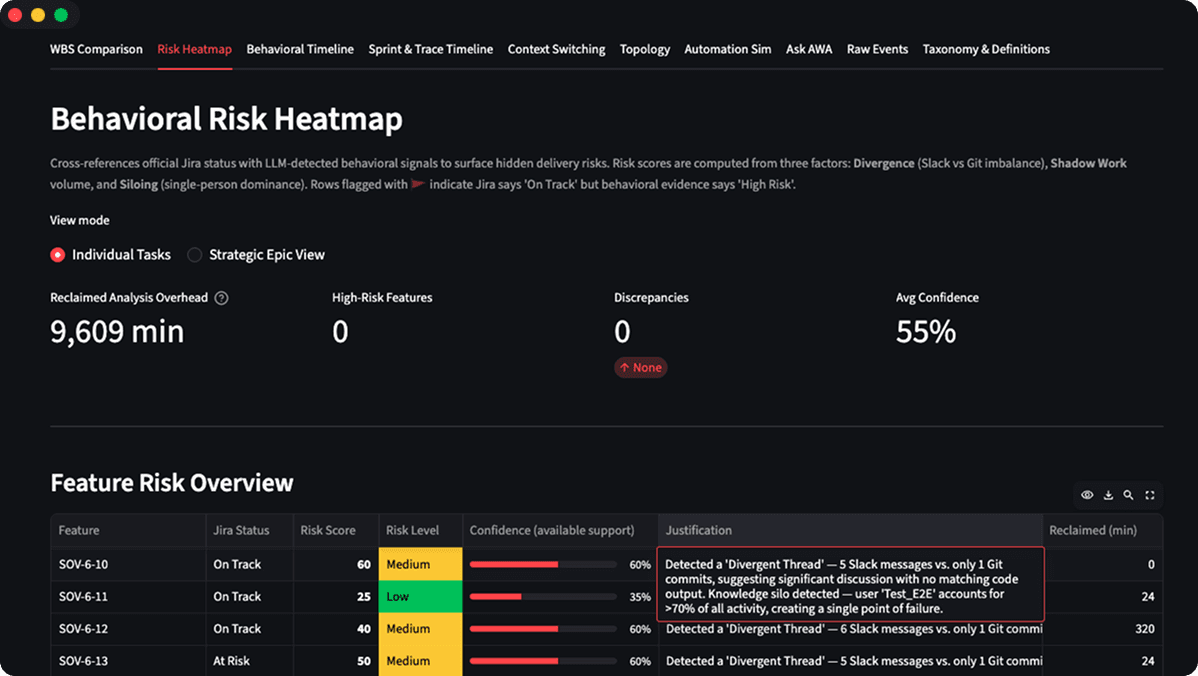
Identifying Hidden Delivery Risks
The Behavioral Risk Heatmap cross-references official status updates with real-time behavioral signals to surface project risks that traditional reporting misses. By analysing the balance between communication and actual output, AWA identifies where a project may be "On Track" in name only, but at high risk of failure in reality.
- Risk Score Analysis: Automatically computes risk levels by evaluating factors like "Divergence" (imbalance between discussion and technical output), Shadow Work volume, and team siloing.
- Detection of "Divergent Threads": Flags discrepancies where high volumes of Slack messages occur without matching code commits, suggesting bottlenecks or planning misalignment.
- Knowledge Silo Identification: Specifically identifies single points of failure where a single user accounts for the vast majority of activity on a critical feature.
- Reclaimed Analysis Overhead: Quantifies the massive amount of manual management time saved (thousands of minutes) by automating the detection of these hidden discrepancies.