
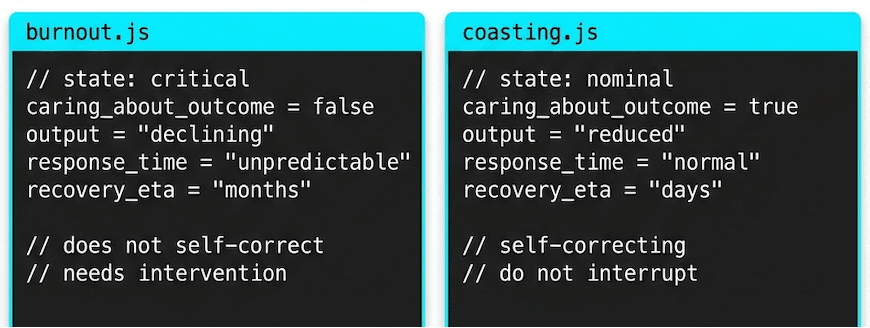
The Post-Launch Slowdown: Coasting or Burnout?
Your best engineers go quiet after a big launch. In my experience, that’s not usually a red flag.
The week after go-live, something often shifts.
The people who were pushing fixes at midnight go quiet. Standups get shorter. They’re still there, just moving at half speed. Many managers do not recognise the difference between coasting and burnout and start worrying that the team has checked out.
But coasting and burnout are not the same thing.
Burnout is a breakdown. Coasting is often a breath.
Burnout rarely arrives with warning. It often shows up first in a fading sense of care for the work itself. By the time it is obvious, recovery may already be measured in months.
Coasting looks different. The person still hits their targets, still responds, still shows up, just without the extra gear engaged. They are still there, just using the time to recover.
When people pour everything into a launch, they often pull back afterward to protect what’s left. What looks like a character flaw may simply be the nervous system doing what it is supposed to do.
The pattern is familiar, and there is research that helps explain it.
Studies discussed in Harvard Business Review have found that on days employees feel most passionate and energised, they often give more, and then report higher exhaustion the next day. The passion and the crash can be linked.
The quieter period after launch is often the repayment phase of sustained effort. The harder the sprint, the more recovery it tends to require.
And as work demands more judgment, more creativity, more of the things that cannot be automated, the size of that debt can increase.
What actually helps
Good engineering teams understand this principle in software. After a big release, you often create a stabilisation cycle, time to fix what the sprint exposed, before piling on new work. People need something similar.
A week or two at lower intensity often serves as maintenance on your most important infrastructure. Risk tends to build when teams are pushed straight into the next major sprint, until the quiet becomes permanent.
Sources: Harvard Business Review, “Don’t Let Passion Lead to Burnout on Your Team” (May 2023); Eagle Hill Consulting / Ipsos, Workforce Burnout Survey (2025).